Intimacy and Connection
Menopause and a Sexless Marriage: When Desire Changes and No One Talks About It
Menopause can quietly turn into a sexless marriage, not because of the physical changes alone, but because of what goes unspoken around them. Here is what is actually happening in the relationship and how couples find their way back to each other.
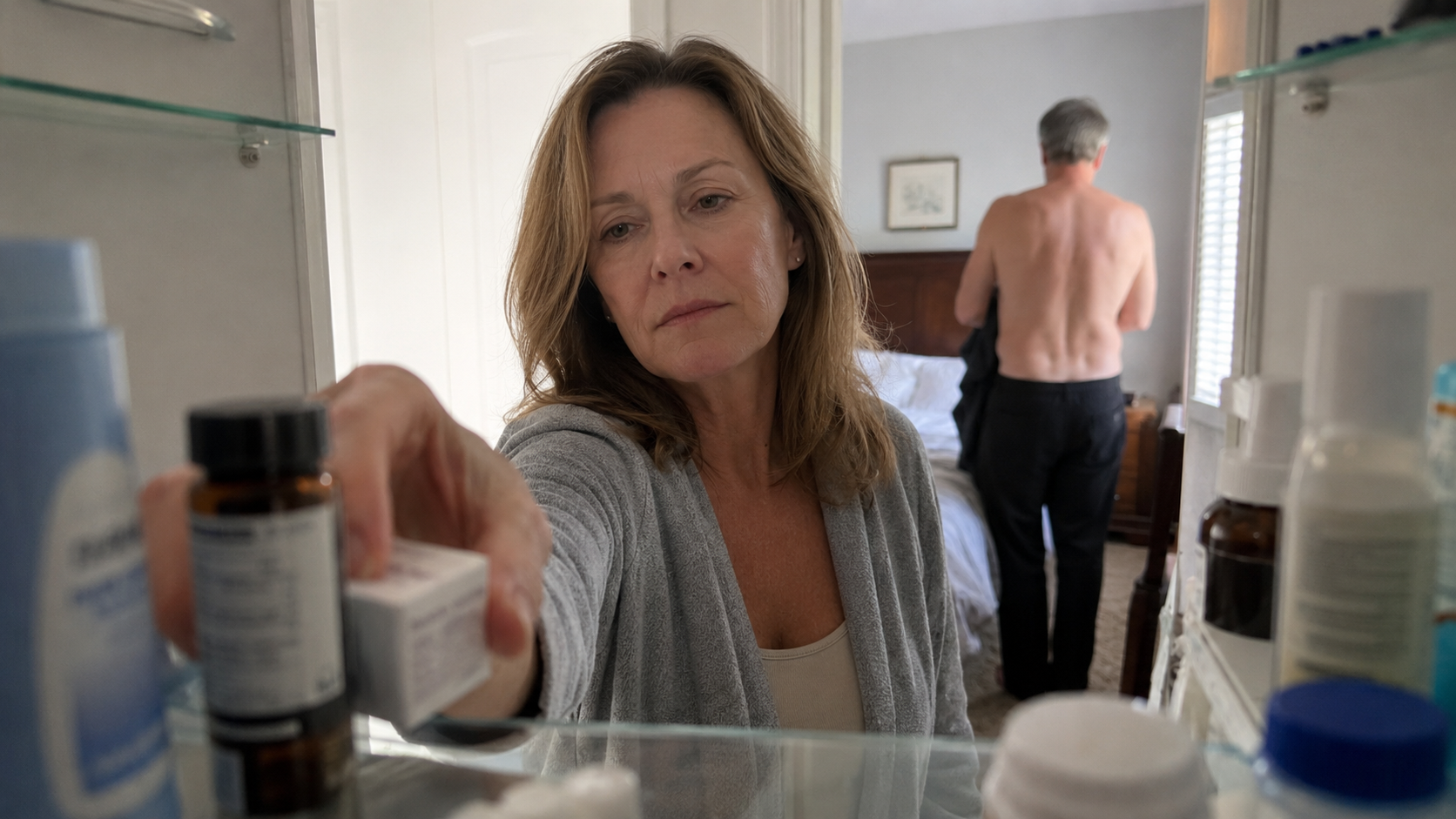
Something changed when menopause arrived. The sex that used to be part of your marriage got less frequent, then rare, then at some point stopped, and now there is a quiet distance between you that neither of you is talking about. You searched this because you are living it, and because the silence around it has started to feel as heavy as the change itself.
There is a lot of medical information about menopause and sex. Hormones, dryness, treatments, the physical mechanics of what changes. That information matters and your doctor is the right person for it. But it is not the whole story, and for many couples it is not even the main story. The reason menopause so often becomes a sexless marriage is usually not the physical change by itself. It is what goes unspoken around it.
This is about that part.
Why menopause becomes a marriage problem and not just a symptom
Menopause becomes a marriage problem, rather than just a physical symptom, because of the silence that grows up around it. The physical changes are real and well documented: the large, long-running Study of Women's Health Across the Nation, which followed thousands of women through the menopausal transition, found that sexual desire tends to decrease and discomfort during sex tends to increase as women move through it. Those changes are genuine, they are not imagined, and they are worth discussing with a doctor or gynecologist who can explain what is happening in the body and what options exist. We are not going to try to cover that here, because it is medical territory and it belongs with a medical professional.
But the physical change on its own does not produce a sexless marriage. What does is that the change goes unnamed.
Here is the pattern. The physical change arrives. Desire shifts, or sex becomes uncomfortable, or a woman simply does not feel like herself in her own body the way she used to. That alone does not end a couple's intimate life. What ends it is that the change goes unnamed. The woman does not know how to bring it up, or feels embarrassed, or does not want to make it a problem. Her partner notices the distance but does not know whether to say something, ask, initiate, or wait. So nobody says anything. The change becomes the thing that is happening but is not being discussed, and the not-discussing becomes its own kind of distance, separate from and often larger than the physical change that started it.
Months pass. The silence calcifies. What began as a physical shift that couples navigate all the time becomes a structural feature of the marriage: a topic too loaded to bring up, an absence too established to easily address. The marriage becomes sexless not because menopause made it inevitable, but because the change happened in silence and the silence was never broken.
That is the part couples have real power over. The physical side is between a woman and her doctor. The silence is between the two people in the marriage, and it is the silence that does most of the damage.
What it feels like from both sides
One of the reasons this is so hard to talk about is that both partners are usually having a difficult and largely private experience at the same time, and neither one fully sees the other's. Menopause is often framed as something that happens to a woman alone, but research on couples consistently finds that it is experienced by both people. One study of menopause and sexual function in women and their spouses found that a notable share of partners reported the changes affecting their own intimacy and relationship, and that the sexual functioning of two people in a couple is interdependent rather than separate. This is a shared experience, even when it is lived in two separate silences.
For the woman, menopause can be a strange and isolating thing to move through. The body is changing in ways that were not chosen and are not fully in her control. Desire may genuinely feel different, and sex that was once comfortable may not be. On top of the physical experience, there is often a layer of pressure that has nothing to do with the body: the sense that she should explain herself, or apologize, or fix something, or reassure her partner that the change is not about him. She may feel a quiet grief about her own shifting relationship to desire, and at the same time feel responsible for managing her partner's feelings about it. That is a heavy combination, and it often gets carried alone.
For her partner, the experience is usually confusion and a slow-building sense of being shut out. The intimacy that was part of the relationship has faded, and the reason is not always clearly communicated, so it gets interpreted. Often it gets interpreted personally. He may wonder whether she is still attracted to him, whether he did something, whether this is permanent, whether he is supposed to keep initiating or back off entirely. Each unsuccessful or unwelcome attempt to connect makes the next one feel riskier, so eventually he stops trying, not out of indifference but out of a wish not to pressure her or to be rejected again. From the outside, that withdrawal can look like he has stopped caring. From the inside, it is usually the opposite: he cares and does not know what to do with it.
What both people are often feeling, separately and silently, is a version of the same thing: loneliness. The specific loneliness of being in a committed marriage to someone you love and feeling a distance between you that neither of you is naming. Each one may believe they are the only one struggling, when in fact both are, in parallel, about the same thing.
That mutual, unseen loneliness is the heart of a menopausal sexless marriage. And it is also the thing that begins to lift the moment the silence breaks.
Why the silence happens
Couples fail to name it mostly because there is no good cultural script for the conversation, and because each partner has private reasons for staying quiet that the other cannot see. If naming it helps so much, it is worth asking why it so reliably does not happen.
Part of it is the missing script. Menopause is still discussed mostly in medical or joking terms, rarely as something that happens inside a marriage to both people. Couples often simply do not have language for what they are going through, so the conversation never finds a starting point.
Part of it is embarrassment and a sense of fault. A woman may feel that her changing desire is a failing, something to hide or minimize rather than share. Naming it can feel like confessing a problem rather than opening a conversation, so she carries it instead.
Part of it is the partner's fear of saying the wrong thing. Many partners sense that this is delicate territory and worry that bringing it up will come across as pressure, complaint, or insensitivity. So they say nothing, choosing silence as the considerate option, not realizing that the silence itself is being experienced as distance on the other side.
And part of it is simply that the longer it goes unspoken, the harder it becomes to speak. A conversation that would have been ordinary early on becomes, after months of silence, a large and frightening thing that seems to require a perfect moment and perfect words. So it keeps not happening.
The result is two people who both want closeness, both feel the distance, and both are waiting for the other to make the first move toward a conversation that neither knows how to begin.
The conversation that helps
The good news in all of this is that the conversation that breaks the silence does not have to be perfect, and it does not have to solve anything. It just has to happen. And the evidence that it is worth having is strong: a meta-analysis of research on couples' sexual communication found that better communication helps explain why some couples stay satisfied with their sex life even as desire changes and difficulties arise, and that openness about sexual preferences is consistently tied to higher satisfaction in long-term relationships. The conversation is not a nice-to-have. For long marriages moving through change, it is close to the whole game.
What tends not to work is leading with the problem. "We never have sex anymore" or "What happened to us" lands as an accusation even when it is not meant as one, and it puts the other person on the defensive. In a menopausal sexless marriage, where one partner may already be carrying shame about the change, that kind of opening tends to close the conversation rather than open it.
What works better is leading with yourself and with care rather than with the deficit. For the woman, that might sound like naming her own experience honestly: that her body and her desire have changed, that it has been hard and a little lonely, that it is not about not loving or wanting her partner. For the partner, it might sound like an honest admission of his own experience: that he has missed her, that he has not known how to bring it up, that he has stayed quiet because he did not want to pressure her, not because he stopped wanting to be close.
The key is to take the pressure off the conversation itself. It helps to say, directly, that you are not trying to fix everything tonight or get back to exactly how things were. You are just trying to stop being alone in it. When the goal of the conversation is connection rather than resolution, both people can be more honest, because the stakes of saying the wrong thing drop.
It also helps to separate the two layers explicitly. The physical side of menopause has real options worth pursuing with a doctor, and naming that the medical part is being handled, or will be, can lift some of the weight from the relationship conversation. That frees the two of you to talk about the part that is actually between you: how you stay close to each other through a change that one of you is living in the body and both of you are living in the marriage.
If you want more on the mechanics of this kind of conversation, the articles on how to talk to your partner about desire and how to ask for what you need in a relationship go deeper.
What rebuilding actually looks like
Rebuilding intimacy after a menopausal dry spell rarely looks like flipping a switch back to how things were. For most couples it looks like building something somewhat new, which is slower but often more durable.
The first thing that usually helps is letting go of the idea that the goal is to return to exactly the sex life you had before. Bodies change, and the intimacy of a marriage in its later decades does not have to be a reproduction of the intimacy of its earlier ones. Couples who navigate this well tend to redefine intimacy rather than try to restore a previous version of it. That can mean a broader idea of what counts as closeness, less focus on a specific script, and more attention to the kinds of connection that still feel good to both people.
The second thing that helps is non-pressured physical closeness. After a long stretch of distance, jumping straight back to sex can feel high-stakes for both people, especially if discomfort or low desire is part of the picture. Reintroducing touch that carries no expectation, holding hands, sitting close, affection that is not a prelude to anything, rebuilds physical connection without the weight. For many couples that is where desire slowly starts to return, once the pressure is off.
The third thing is recognizing that the physical and the relational can be worked on in parallel. A woman can pursue medical options for the physical side with her doctor while the couple works on the relational side together. Neither one has to wait for the other. Progress on the medical front can ease the relationship, and progress on the relationship can make the medical front feel less lonely to navigate.
And underneath all of it is the same thing that keeps desire alive in any long marriage: two people who remain distinct and interested in each other, rather than two people who have merged into a single domestic unit. Keeping some sense of yourselves as separate people, with your own lives and interests, is part of what makes coming back together meaningful.
The how to rebuild intimacy after a dry spell article covers the practical arc of this in more detail. The broader picture of how intimacy shifts after 40 is worth understanding alongside the menopause-specific changes.
When to get help
Sometimes the conversation is too hard to have alone, or the distance has been there too long to bridge without support, and that is a good reason to bring in a professional rather than a sign of failure.
For the physical side of menopause, a doctor or gynecologist is the right person. There are real medical options for the physical changes that affect intimacy, and they are worth pursuing. Do not let the relationship conversation substitute for the medical one, or the other way around. They are separate and both matter.
For the relationship side, a couples therapist with experience in both intimacy and life-stage transitions can help. A therapist who understands the specific dynamics of menopause in a marriage, the mutual loneliness, the unspoken assumptions, the way silence builds, can help both people say the things they have not been able to say to each other. The AASECT directory and the Gottman Referral Network both let you find therapists with relevant experience.
A note on what this is and is not
This article is about the relationship. It is not medical guidance, and it does not try to be. The physical changes of menopause, the reasons desire shifts, the discomfort some women experience, and the options that exist to address them are all real, and they are all questions for a doctor. Nothing here is a substitute for that conversation.
What this article is about is the part of a menopausal sexless marriage that lives between two people: the silence, the loneliness, the assumptions, and the conversation that begins to undo them. That part is not medical. It is human, and it is something the two of you have real power over, together.
How Couplewink fits
The hardest moment in a menopausal sexless marriage is often the simplest one to describe: both people want to feel close again, and neither wants to be the first to say so. After a long silence, the first move feels too risky for either person to make.
Couplewink was built for exactly that moment. Each partner shares privately what they are open to, and the app only surfaces a match when both people are interested. Nobody has to make a move that might not land. Nobody has to guess what the other is feeling. The silence gets broken without either person having to be the one who breaks it.
It does not address the physical side of menopause, and it is not a substitute for the conversations above. But it can be a low-pressure way back into connection when the distance has made the first step feel impossible.